
What Can You Do With a Health and Wellbeing Coach Certificate? Six Career Pathways Explained
A health and wellbeing coach certification can lead to employed roles in NHS primary care, education, the charity and third sector, and corporate wellness, as well as to self-employment in private practice. Health and wellbeing coaching is now a recognised NHS role, employed directly within GP surgeries, and demand is growing across every sector as they realise that wellbeing cannot be left to chance.
What can I do with a Health and Wellbeing Coach Certificate? It is a question I am asked a lot, so let me walk you through the career pathways as I explain them to my own students.
1. The NHS: health and wellbeing coaches in primary care
This is the pathway that has changed the landscape most in recent years.
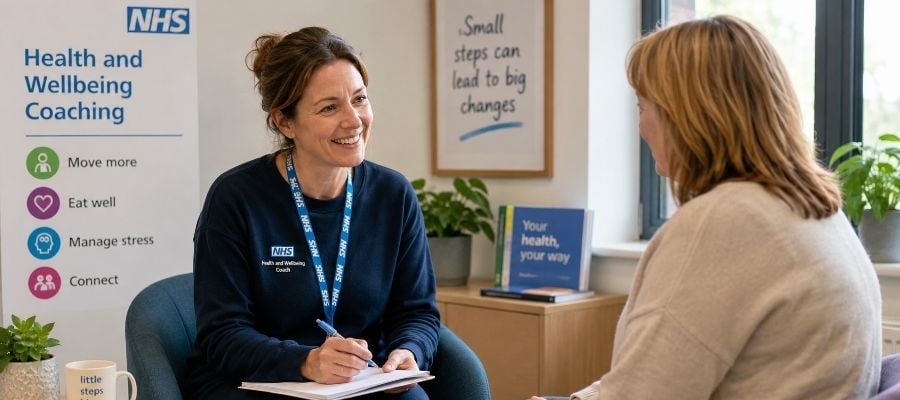
The NHS is employing health and wellbeing coaches to work directly within GP surgeries, funded through the Additional Roles Reimbursement Scheme (ARRS) as part of Primary Care Networks. These coaches work with individuals and groups — often people living with long-term conditions — to help them build the knowledge, skills and confidence they need to manage their own health.
The evidence behind this approach, known as supported self-management, is substantial:
I find that figure remarkable, and it confirms something I have believed for my whole coaching career: when people are supported to take agency over their own health, everything shifts. Health coaching isn’t a nice-to-have on the edges of healthcare. It is becoming part of the infrastructure.
A practical note: NHS England advises that health and wellbeing coaches complete training accredited by the Personalised Care Institute (PCI). If the NHS pathway appeals to you, check that any training you are considering carries PCI accreditation.
One of our graduates, Simone, took exactly this route:
“My Raw Horizons training has changed my life! It was the catalyst for change, and not only in helping others but also in me leading a healthier lifestyle too. I now run my private practice plus deliver group coaching for the NHS Healthier You Diabetes Prevention Programme.”
2. Education: pupil and staff wellbeing
Schools, colleges and universities are increasingly employing dedicated wellbeing roles — such as education wellbeing officers, student wellbeing coaches and wellbeing support officers.

This responsibility used to fall informally to a teacher who took it on alongside everything else. Now education institutions are recruiting distinct wellbeing officer roles to support students in:
There is also growing recognition that staff wellbeing needs the same attention — supporting teachers and school leaders who carry enormous stressful loads. If you have a background in education, this pathway lets you bring your understanding of that world together with proper wellness coaching skills.
3. The charity and third sector
Charities employ wellbeing coaches across a wide range of missions, such as:
Organisations like St Giles Trust and Working Well Trust, for example, employ personal wellbeing coaches and practitioners to do precisely this work. See what employment opportunities are available for wellbeing coaches here.

What I love about this pathway is that coaching here often reaches people who would never book a session with a private coach. If your motivation for training is service — being useful to people at genuinely difficult points in their lives — the third sector is worth a serious look.
4. Corporate wellbeing
Organisations have woken up to the fact that a stressed, burnt-out workforce serves nobody — and that investment creates real roles: corporate wellness coaches, wellbeing advisors, and wellbeing consultants.
The day-to-day work is varied. Depending on the organisation, you might be:

There are three main ways coaches find this work:
A word of caution from me: corporate wellbeing done badly is putting all the responsibility onto employees to tend to their own wellbeing through a class the employer has offered — without giving them the time to attend it. When done well, corporate wellbeing involves skilled coaches helping real people change how they work and live. Employers increasingly know the difference — which is why certified wellbeing coaches, trained on accredited courses, are the ones being hired.
5. Wellbeing policy and strategy
That last piece points to a related pathway of its own: helping organisations design the policies and procedures that shape how their people are actually supported — embedding wellbeing into how the place runs, rather than leaving it as a well-meaning afterthought.
This is a real and growing field. Organisations across the UK now recruit wellbeing leads, wellbeing managers and heads of wellbeing — roles responsible for an organisation’s whole wellbeing strategy rather than delivering individual wellness sessions. And there is now an international standard behind this work: ISO 45003, published in 2021, gives employers practical guidance on managing psychological health and safety at work — covering workloads, working relationships, culture and leadership.

In practice, this pathway tends to look like:
This position is rarely a first role straight out of training. But for coaches with a background in HR, management or organisational life, it can be a natural direction — your coaching skills become the foundation for shaping how a whole organisation supports its people.
6. Private practice: your own business
And of course, there is working for yourself: building your own business, working with clients one-to-one or in groups, helping people establish the lifestyle habits that support their wellbeing.
This is the pathway with the most freedom — you choose your niche, your hours, and your way of working. It is also the one where your coaching skills alone aren’t quite enough; you’ll be learning to run a business too — which is why our training includes lessons on how to start your coaching business.

People arrive at this pathway from everywhere. Some are yoga teachers, retreat facilitators or personal trainers, adding coaching skills to what they already offer so they can support the whole person rather than just the hour on the mat or in the gym. Some have been on their own wellbeing journey and want to help others properly, with real skills and ethical grounding. And many come from careers that have nothing to do with wellness at all — just the desire to support others on a lifestyle transformation.
Many of our graduates blend pathways. Simone, as mentioned above, runs a private practice alongside her NHS group coaching. That mix of some employed or contracted work for stability plus some private clients for freedom is a very common and very sensible shape for a coaching career.
Frequently Asked Questions
If you are exploring whether this is the right career for you, our certified Health and Wellbeing Coach Training offers three pathways to suit different lifestyles — 5-day Live Immersive, 5-month Blended Integrative and Flexible Self-study Independent — with our live pathways dual-accredited by the Association for Coaching and the NHS Personalised Care Institute. You will learn the same rigorous curriculum whichever you choose and leave equipped to step into any of the wellness career pathways above.
NOTE: Advertised positions may require additional skill sets to those taught in the Health and Wellbeing Coach Training.